
Guided by a ‘Mantra,’ This Student Is Reimagining Justice Through Data Science
The McCourt School of Public Policy’s Tech & Public Policy program Scholar Joya Wheatfall-Melvin (MS-DSPP’26) is using data to advance equity in criminal justice and education.
For Joya Wheatfall-Melvin (MS-DSPP’26), the power of data lies in its potential to be a driver of change.

Joya Wheatfall-Melvin (MS-DSPP’26)
“Data, when handled with care and context, can become a tool for liberation,” she says.
This “mantra,” as Wheatfall-Melvin calls it, has guided her work as a data scientist and Tech & Public Policy (TPP) program Scholar. Her journey to McCourt began in a data analysis class at her alma mater, Spelman College. It was one of her professors, passionate about bringing more Black women into coding, who introduced her to the discipline.
She then landed a pivotal internship at the University of Virginia, exploring the intersection of data science and equity. The experience exposed her to data showing disparities in how Covid-19 pandemic aid was allocated across municipalities in her home state of Virginia. Regions where aid was underallocated were in predominantly Black communities.
“That’s when I learned that data can really shape people’s lives,” she says.
After UVA, she applied her skills at institutions including Brown University, Purdue University and the School for International Training, supporting mission-driven projects that strengthened her interest in using data for public good.
Passionate about diving deeper into the field, she was ready to take her data science skills to strengthen public policy outcomes – this time, in the nation’s capital.
Closing data gaps and advancing equity
Shortly after arriving at McCourt, Wheatfall-Melvin put her data justice mantra into practice through her first research project as a graduate student, “Last Girl Standing.” The project examined harm and opportunity for Black girls in alternative schooling environments, where students are typically sent as a final intervention before juvenile court involvement.
Through the research, she found that while overall juvenile detention rates have declined, Black girls with disabilities remain consistently overrepresented in those detention rates. “There was a lot of missing data when it came to Black girls,” she says. “When you don’t have granular data, people rely on group averages, which can reinforce harmful assumptions.”
Raised in a family of Southern educators, Wheatfall-Melvin saw the project as a natural extension of her commitment to education and equity — sharpening her focus on the intersection of education policy and criminal justice.
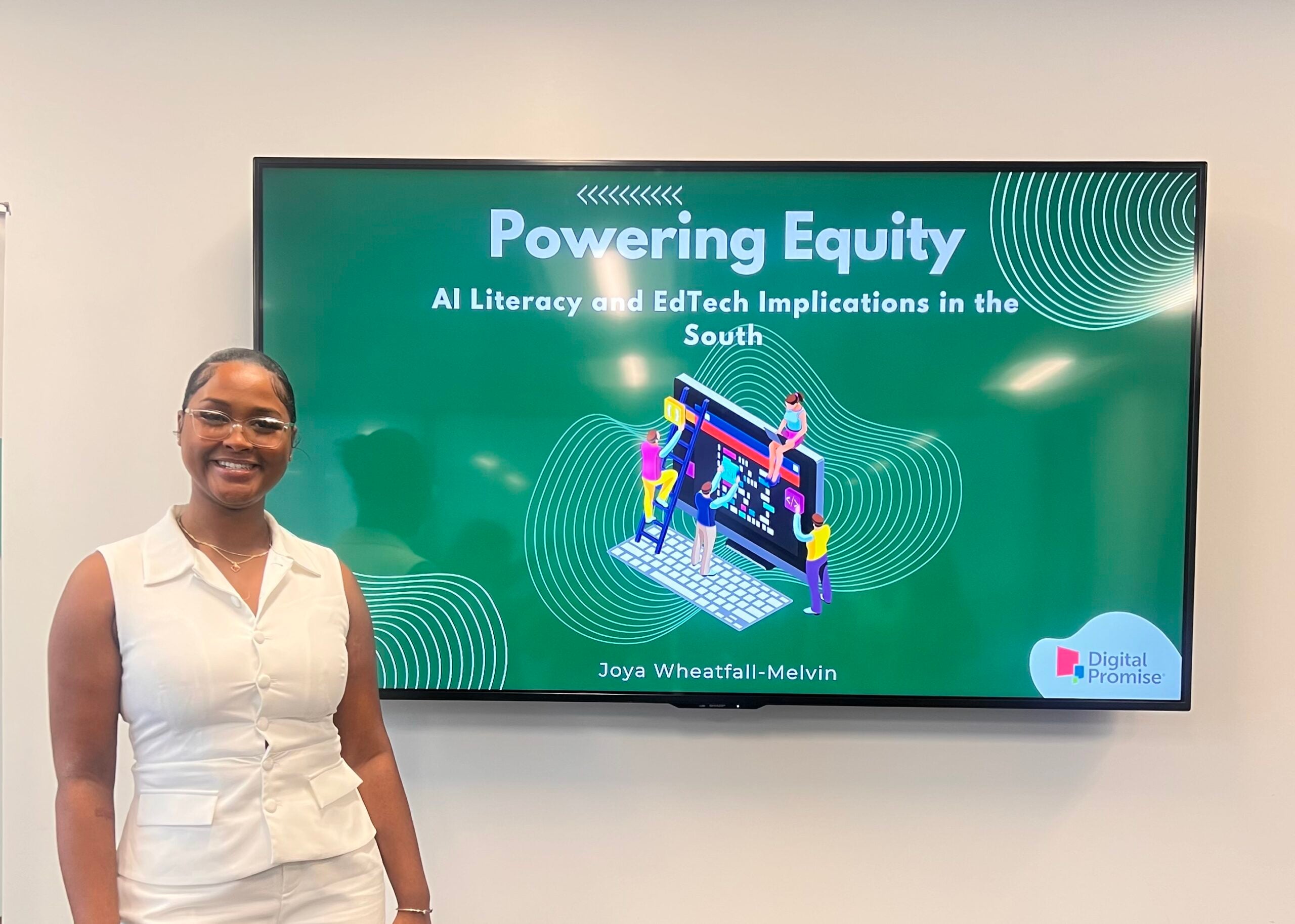
Joya Wheatfall-Melvin (MS-DSPP’26) worked as a workforce analyst at the Joint Center for Political and Economic Studies through the Peter G. Peterson Fiscal Fellowship after her first year at the McCourt School.
“Last Girl Standing” laid the groundwork for Wheatfall-Melvin’s focus on criminal justice, where she now applies data science at scale through the Evidence for Justice Lab, directed by McCourt School Associate Professor Andrea Headley. As a TPP Scholar, she serves as the project lead for the Lab’s Justice and AI Tracker, the nation’s largest database documenting the use of artificial intelligence in courts, corrections and police departments.

Joya Wheatfall-Melvin (MS-DSPP’26) with 2025-2026 and 2026-2027 Tech & Public Policy Scholars cohort.
“When I started working for the Evidence for Justice Lab, I began to see how I could provide transparency within my own community, the Black community, using technology and data science,” she says.
The Justice and AI Tracker tracks where and how AI tools are deployed across the criminal justice system, addressing an environment where information on AI use is often fragmented or unavailable. In her role, Wheatfall-Melvin oversees a team of eight researchers and leads the project’s data collection and methodology, ensuring the tool remains both rigorous and accessible.
“I’ve grown my technical skills significantly,” she says. “My colleague Togzhan Zhumadil, who is a research assistant for the Lab, and I even built the project website using JavaScript and Cascading Style Sheets software, something I had never done before.”
Her growing expertise is now shaping policy beyond McCourt. As an advisory committee member for the National Student Legal Defense Network’s AI Practices & Ethics initiative, Wheatfall-Melvin is translating lessons from criminal justice AI into recommendations for how universities should govern AI technologies, applying her data justice framework to higher education.
As she looks ahead, Wheatfall-Melvin hopes to remain at the intersection of data science and the public good, using technology to serve communities that are often overlooked. “I want to continue working in spaces that generate evidence to shape policy and pour back into my community,” she says.