The Whittington Lecture
The Whittington Lecture and Scholarship allow the McCourt School to celebrate Leslie Whittington’s memory, her passion for teaching and her service to the McCourt community.
Held annually, the Whittington Lecture invites thought-leaders and change-makers to the McCourt School to deliver talks addressing pressing societal challenges, blending rigorous analysis and community engagement.
About Leslie A. Whittington
Leslie A. Whittington, along with her husband Charles Falkenberg and two children, Zoe, 8, and Dana, 3, died tragically on September 11, 2001, when American Airlines flight 77 was hijacked and crashed into the Pentagon.
Leslie was a committed and effective teacher. She taught economics and public finance, in addition to many electives. Loved by her students who appreciated her lively and engaging lectures, Leslie received numerous awards for her excellence in teaching. Leslie not only helped build GPPI, but also a community of policy professionals in Washington, throughout the nation, and around the world. She served as GPPI’s Associate Dean from 1999 to 2001.
A renowned expert on the “marriage tax,” Leslie was in the process of writing two books — one on resolving the often conflicting obligations of work and family and the other a study of taxes that affect families and children. Her work was among the first to demonstrate that taxes play some role in the most intimate of family decisions.
Leslie received her bachelor’s degree in business from Regis College at Denver, and her master’s degree and Ph.D. in economics from the University of Colorado-Boulder. She became an assistant professor at the University of Maryland in 1989, where she taught until she joined GPPI in 1996.
Whittington spotlight stories
-

Twenty-Five Years After 9/11: Remembering Professor Leslie Whittington
On the 25th anniversary of the 9/11 attacks, the McCourt community remembers beloved Public Policy Institute Associate Professor and economist Leslie Whittington.
-
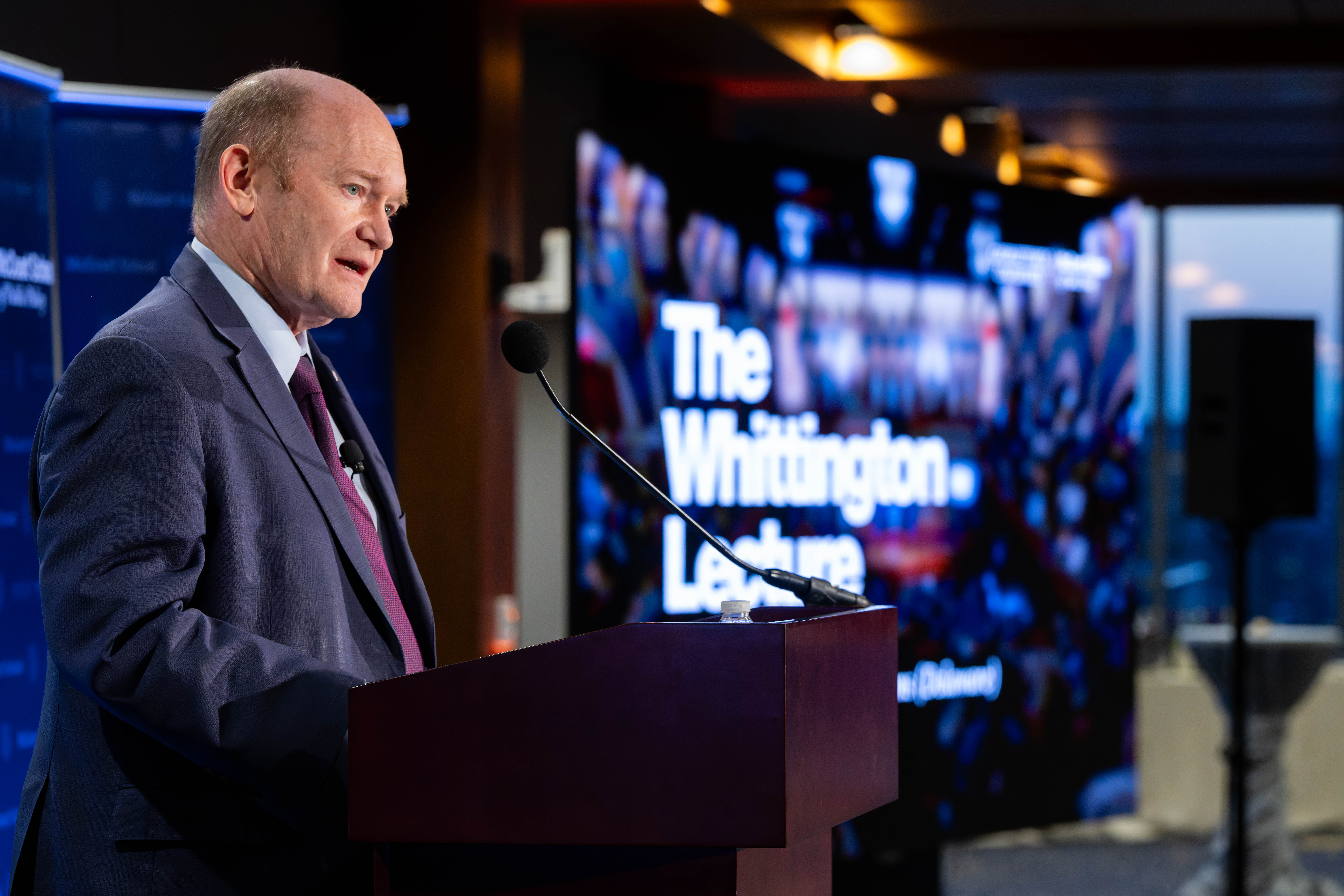
U.S. Senator Chris Coons Urges ‘Opportunity, Security and Justice’ at Whittington Lecture
At the McCourt School of Public Policy’s 2025-2026 Whittington Lecture, U.S. Senator Chris Coons (D-DE) offered what he sees as a forward-looking policy framework designed to speak to a frustrated…
-

When Teaching Exposed Inequality, She Turned to Public Policy for Answers
As the 2025-2026 Whittington Scholar, Britney Cheung (MPP’26) is drawing on her experience as a teacher and a commitment to expanding opportunity for underserved communities.
Whittington Lecture archive
View recordings of previous Whittington Lectures or read our annual event recap.
Previous speakers
Adriana Kugler – 2025 Whittington Lecture
Gov. Adriana D. Kugler is currently a member of the Federal Reserve Board of Governors.
Adriana D. Kugler has spearheaded transformative policy initiatives across multiple high-level government positions. As Chief Economist at the U.S. Department of Labor (2011-2013), she shaped national employment policy during critical economic recovery years. She became the first Latinx Executive Director representing the U.S. at the World Bank in 2022, where she led efforts addressing global food insecurity and expedited budget support to Ukraine. Currently serving as the first Hispanic member of the Federal Reserve Board of Governors in its 109-year history, she leverages her labor market expertise to guide monetary policy affecting millions of Americans.
Dr. Kugler is also a Full Professor at the McCourt School of Public Policy at Georgetown University.
Dr. Anthony Fauci – 2024 Whittington Lecture
Dr. Anthony Fauci is the former director of the National Institute of Allergy and Infectious Diseases at the National Institutes of Health and distinguished university professor in the Georgetown School of Medicine and the McCourt School of Public Policy.
As Director of the National Institute of Allergy and Infectious Diseases, Dr. Anthony Fauci advised seven U.S. presidents on infectious disease policy. He played central roles in America’s responses to HIV/AIDS, SARS, H1N1, Ebola, and COVID-19. His research contributions advanced immunology and infectious disease treatment, while his leadership helped establish frameworks for rapid vaccine development and pandemic preparedness.
His 2024 Whittington Lecture was entitled “Pandemic Preparedness and Response: Lessons from COVID-19.”
Chiquita Brooks-LaSure – 2022 Whittington Lecture
Chiquita Brooks-LaSure is the Centers for Medicare & Medicaid Services Administrator and McCourt School of Public Policy alum (MPP ’99).
As CMS Administrator, Chiquita Brooks-LaSure is the first Black woman to oversee the agency in its 60-year history. In her role, she enrolled over 100 million people into Medicaid coverage to achieve the lowest uninsured rate in U.S. history. She implemented a $2,000 cap on out-of-pocket prescription drugs costs for Medicare enrollees and successfully negotiated drug price reductions. As Deputy Director at CMS under President Obama, she led the Affordable Care Act to passage and implementation. She has focused on expanding healthcare access and affordability for vulnerable populations while managing programs serving half of all Americans.
For the 2022 Whittington Lecture, she spoke on “Meeting People’s Need in Moments of Crisis”.
Hakeem Jeffries – 2021 Whittington Lecture
Hakeem Jeffries NY-08) (MPP’94) is Chairman of the House Democratic Caucus in the U.S. House of Representatives.
As Chairman of the House Democratic Caucus, Hakeem Jeffries actively led transformative criminal justice reform as the first person of color to lead a major party in Congress. He co-authored the landmark First Step Act, which eased mandatory minimum federal sentences, expanded early releases, and ended draconian practices such as the shackling of women inmates giving birth. Jeffries spearheaded the EQUAL Act to eliminate sentencing disparities between crack and powder cocaine, championed legislation to end prison-based gerrymandering in New York State, and co-sponsored the MORE Act for cannabis decriminalization. He fought foreclosures as a state assemblyman and continues driving progressive housing policy.
For the 2021 Whittington Lecture, he spoke about Congress’ role in passing key policy priorities, such as the Raise The Wage act, the Paycheck Fairness act, the John Lewis Voting Rights act, and a variety of key policy challenges, such as climate change and student loan debt.
Robert Doar – 2020 Whittington Lecture
Robert Doar is the President of American Enterprise Institute.
As AEI President, Robert Doar actively transformed American welfare policy through strategic leadership and evidence-based reform. As NYC Human Resources Administration Commissioner, he oversaw a 25 percent reduction in New York’s welfare caseload while helping place almost 87,000 recipients in jobs annually. He spearheaded record-breaking child support collections of $731 million in 2011 with over 91 percent going directly to custodial parents. Additionally, he recruited dozens of leading scholars and launched a new research division focused on social, cultural, and constitutional studies. He co-chaired the National Commission on Hunger and led the AEI-Brookings Working Group on Poverty and Opportunity producing bipartisan policy solutions that bridge conservative and progressive approaches to anti-poverty initiatives.
For the 2020 Whittington Lecture, he spoke on the importance of employment in providing a stable wage for low-income workers, leveraging the full efficacy of our social safety net, and promoting happier, healthier outcomes for families and communities.
Dr. Kristalina Georgieva – 2018 Whittington Lecture
Dr. Kristalina Georgieva is an environmental economist, Managing Director of the International Monetary Fund, and former CEO of the World Bank.
As Managing Director of the International Monetary Fund, Kristalina Georgieva was the first person from an emerging economy to lead the institution. Previously, she held senior positions at the World Bank for nearly two decades, including CEO, overseeing global development programs. As European Commissioner for International Cooperation and Development, she managed humanitarian aid and crisis response. Under her IMF leadership, she has championed climate-resilient economic policies, expanded emergency lending during COVID-19, and advocated for integrating environmental sustainability into macroeconomic frameworks.
For the 2018 Whittington Lecture, she spoke on “The Future of Work” and how technology will shape our response to climate change and continue to push the global economy forward.
Thomas Perez – 2016 Whittington Lecture
Thomas Perez is the United States’ 26th Secretary of Labor.
Secretary Perez has driven transformative labor and civil rights policy throughout his distinguished career. As U.S. Secretary of Labor, he expanded overtime protections for millions of workers, implemented the fiduciary rule protecting retirement savings and established wage increases and paid sick leave for federal contractors. Previously, as Assistant Attorney General for Civil Rights, he prosecuted employment discrimination cases and safeguarded voting rights while taking record-setting enforcement actions. He successfully mediated the 2016 Verizon strike resolution and championed comprehensive workplace safety reforms that strengthened protections for American workers nationwide.
For the 2016 Whittington Lecture, he spoke on the need for diversity and shared prosperity, and its connections to creating successful policies and programs.
Richard Durbin – 2015 Whittington Lecture
Richard Durbin is the 47th U.S. Senator from the State of Illinois, the state’s senior senator, and the convener of Illinois’ bipartisan congressional delegation.
Senator Durbin has championed transformative immigration reform and judicial oversight throughout his distinguished Senate career. He authored the landmark Dream Act over 20 years ago, pioneering bipartisan legislation to provide pathways to citizenship for undocumented immigrants brought to America as children. As Senate Democratic Whip since 2005 and current Judiciary Committee Ranking Member, Durbin has confirmed dozens of federal judges while leading oversight of Trump administration policies. He secured increased federal funding for childhood asthma prevention, immunizations, and global AIDS combat while advocating for campaign finance reform and expanded Amtrak funding.
For the 2015 Whittington Lecture, he spoke on his experience driving policy change by building bipartisan support.
Elizabeth Warren – 2014 Whittington Lecture
Elizabeth Warren was elected to the U.S. Senate in 2012, where she has since served as a Massachusetts senator.
Senator Warren has transformed consumer financial protection through groundbreaking academic work and government service. She originally proposed the Consumer Financial Protection Bureau in 2007 while serving as a Harvard Law School professor, conceptualizing the agency that has revolutionized financial oversight. As Chair of the Congressional Oversight Panel for the Troubled Asset Relief Program (TARP) following the 2008 financial crisis, Warren conducted rigorous oversight of the $700 billion bank bailout, holding Treasury officials accountable through monthly reports to Congress. President Obama appointed her as Special Adviser to help establish the CFPB, where she laid the foundation for an agency that is now a powerful advocate for American consumers.
For the 2014 Whittington Lecture, she spoke on “Collateral Damage, National Interests and the Lessons of a Decade in Conflict.”
Richard Lugar – 2013 Whittington Lecture
Richard Lugar is the President of the Lugar Center and U.S. Senator from Indiana.
Senator Lugar has distinguished himself as one of America’s foremost foreign policy statesmen through groundbreaking bipartisan legislation and diplomatic leadership. He co-authored the landmark Nunn-Lugar Act with Georgia Democrat Sam Nunn, creating the Cooperative Threat Reduction program that has secured and dismantled thousands of nuclear, biological, and chemical weapons throughout the former Soviet Union. As Chairman of the Senate Foreign Relations Committee from 1985-1987 and 2003-2007, Lugar has championed nuclear non-proliferation initiatives while leading efforts to end U.S. support for South Africa’s apartheid regime and combat electoral fraud in the Philippines. His pragmatic approach to diplomacy has made him a trusted voice on global security issues.
For the 2013 Whittington Lecture, he spoke on the partisan strife in Congress, which he believes will continue unless members from each party step up to catalyze change.
Paul Ryan – 2012 Whittington Lecture
Paul Ryan (WI-01) is the Chairman of the House Budget Committee and represents Wisconsin’s 1st congressional district in the U.S. House of Representatives.
Congressman Ryan has emerged as the Republican Party’s leading fiscal conservative through his bold budget proposals and policy innovation. He authored the groundbreaking “Roadmap for America’s Future” in 2008, presenting comprehensive reforms to Social Security, Medicare. As the ranking Republican member on the House Budget Committee, Ryan crafted detailed alternative budgets including “The Path to Prosperity,” which proposes significant spending cuts and entitlement reforms. His intellectual approach to fiscal policy has established him as a prominent conservative voice on economic issues, drawing both praise and criticism for his willingness to tackle politically sensitive topics.
For the 2012 Whittington Lecture, he spoke on “America’s Enduring Promise” and the case for Budget in the face of a growing deficit and slowing economic progress.
Steven Chu – 2010 Whittington Lecture
Steven Chu is the U.S. Energy Secretary.
Secretary Chu has brought unprecedented scientific expertise to the Department of Energy as the first Nobel laureate to lead the agency. Since his appointment in January 2009, Chu has spearheaded President Obama’s clean energy agenda, implementing massive renewable energy investments through the American Recovery and Reinvestment Act. He has established the groundbreaking Advanced Research Projects Agency-Energy (ARPA-E) to accelerate breakthrough energy technologies and launched the Energy Innovation Hubs program to tackle critical challenges in solar energy, energy storage, and building efficiency. Previously directing Lawrence Berkeley National Laboratory, Chu brings his Nobel Prize-winning expertise in laser physics to drive America’s transition toward sustainable energy independence.
For the 2010 Whittington Lecture, he spoke on the ways to meet the energy and climate challenge.