
New research from McCourt’s Massive Data Institute and Evidence for Justice Lab gives states a way to assess AI readiness, while examining existing AI implementation efforts.
States are moving fast on AI adoption. As of 2025, 47 states were considering AI-related legislation, and 34 had formed a group or standing committee to study it. But how prepared is any given state to adopt AI responsibly and effectively? A new report from researchers at the McCourt School’s Massive Data Institute (MDI) and Evidence for Justice Lab (E4J) offers a way to find out.
Led by Professor Lisa Singh, a team of faculty, staff and students developed a framework for assessing state AI readiness. Co-authors of the report include Andrea Headley, associate professor and E4J faculty director; Vinuri Dissanayake, E4J deputy director; Aditi Bhardwaj, MDI data scientist; Henry Deng (C’26); Bhumika Nebhnani (MPP’27) and Saanvi Shashikiran (C’27).
They then applied the framework to California and Florida. Their findings illustrate how, according to the framework, the data needed to measure readiness does not exist yet for many states.
“States need to understand how ready they are because having a baseline gives direction to where they need to invest next,” says Headley.
A framework that goes beyond technical capacity
The researchers examined existing AI readiness frameworks. These ranged from state-level assessments by Code for America, the Council of State Governments and Rutgers University to global indices from Oxford Insights, the International Monetary Fund and the United Nations.
The report finds AI Readiness is largely framed as something governments and markets achieve, rather than something shaped by the people closest to the technology.
Notably, the team highlights that existing frameworks tended to overlook the people affected by AI. Public perceptions, equity considerations, and procurement were largely absent from existing frameworks, even though governments often buy AI tools rather than build them.
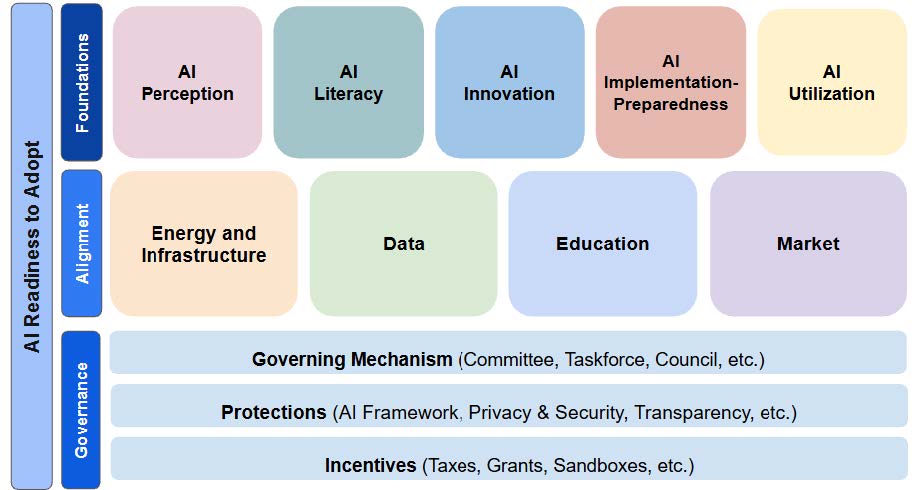
Their research offers a new way of thinking about AI readiness by creating a framework based on three pillars. The first, Foundations, covers the basic elements needed to increase AI-specific capacity within a state, including public perceptions of AI, AI literacy, innovation, implementation preparedness and actual AI use. The second, Alignment, addresses the adjacent systems that make AI scalable, such as energy and infrastructure, data and STEM education. The third, Governance, encompasses the formal rules that shape AI use, including governing bodies, protections and incentives like grants and regulatory sandboxes.
Comparing California and Florida on AI Readiness
To show the framework in action, the team compared California and Florida, two large states with different approaches to AI. Each state showed strengths in different areas.
Florida stands out when it comes to implementing AI standards in K–12 education. The state recently adopted a statewide AI-specific Career and Technical Education (CTE) program, developed in partnership with the University of Florida. The program focuses on technical skill proficiency and competency-based applied learning of AI, with many high schools in the state planning to adopt this program. California highlights computer science as a standalone learning standard on par with math and science, but has not yet implemented a statewide AI-specific CTE program at the same scale as Florida.
On the other hand, California leads when it comes to government readiness. The state has tested AI models from major developers across several state agencies, issued procurement guidelines for generative AI and offered AI training to government workers. Florida has no equivalent testing environment or guidelines. California is also home to 33 of the world’s top 50 AI companies, compared with one in Florida.
The comparison also showed how much remains unknown about these states’ respective approaches. Comprehensive state-level data on public perceptions of AI is not yet available for either state.
“One reason we added this case study was the difference in approach taken by both of these states, highlighting the wide variance across states on AI-preparedness,” says Singh. “We would expect California to be leading the way across all the pillars, but it is not. We would expect Florida, as a high-economy state, to have more incentives from a pro-business governor, but there were none. The clear differences of these two states highlight why it is so important to begin to collect the data and understand the level of AI-readiness associated with every state.”
What’s next for state readiness
The research concludes that data must be collected as a first step to measure the different components identified in the framework. Furthermore, the researchers highlight the importance of sharing collected insights with the public to increase transparency around AI adoption efforts.
“Regardless of where a state is on its journey, recalibrating towards a more considered approach to adoption can mitigate harms and enhance the potential of AI to work towards the public good,” the report states.
To learn more, access the full report.